Pakmodrupa Dorje Gyalpo
ཕག་མོ་གྲུ་པ་རྡོ་རྗེ་རྒྱལ་པོ་
1110 – 1170


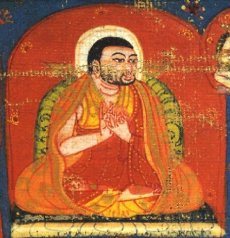
Pakmodrupa was a disciple of Gampopa and is one of the earliest patriarchs of the Kagyu tradition. His monastery, Densatil, which he founded in 1158, was the training ground for most of the founders of the Kagyu sub-traditions, such as Taklungtangpa and Jikten Gonpo, who went on to establish the Taklung and Drigung Kagyu, respectively. He integrated teachings that he received from Kadam, Sakya and, in vision, Zhije instructors into those he received from Gampopa. A widely learned but humble monk, he gave a clear priority to meditation over textual scholarship and philosophical reflection. His collected works have only recently been published in full.
... read more at 
Mentioned in
Khenpo Tamphel at the 2019 Tathāgatagarbha Symposium
Drawing on the text entitled A Mahāmudrā Investigation into Confusion: An Instruction for Identifying the Process of Confusion by Jikten Sumgon, Khenpo Tamphel explains how, according to this text, sentient beings and buddhas are related, how confusion arises that leads to saṃsāra, and how recognition of the true nature of sentient beings is the way to enlightenment.
Tamphel, Khenpo Könchok. "The Difference Between a Sentient Being and a Buddha: 'Jig rten gsum mgon’s Instruction on the Process of Confusion." Paper presented at the University of Vienna Symposium, Tathāgatagarbha Across Asia, Vienna, Austria, July 2019. Video, 47:23. https://www.youtube.com/watch?v=3GbYgx3ozDM.
Martina Draszczyk at the 2019 Tathāgatagarbha Symposium
Martina Draszczyk discusses the early Kagyu masters and explores how their meditation-oriented approach is based in both affirming buddha-nature as the ground and goal of Buddhist soteriology and avoiding its reification into an entity with real properties.
Draszczyk, Martina. "Buddha Nature as Seen by Early Bka’ brgyud Masters." Paper presented at the University of Vienna Symposium, Tathāgatagarbha Across Asia, Vienna, Austria, July 2019. Video, 37:27. https://www.youtube.com/watch?v=MoMUdg40Qv8.
Philosophical positions of this person
Is buddha-nature considered definitive or provisional?
Is buddha-nature equated with emptiness or alayavijnana?
Do the author's writings belong to the analytic or meditative tradition of Uttaratantra exegesis?
What is Buddha-nature?
Tathāgatagarbha as the Resultant State of Buddhahood
- From Śākya Chogden's summary of the main positions on buddha nature his view is included among the heading "Asserting buddha nature as the compound of natural purity and buddha qualities’ being inseparable" and with the sub-heading of "Asserting those qualities to be the qualities of the fruitional dharmakāya of realization (many Kagyüpas such as Pamo Trupa)." Brunnhölzl, K., When the Clouds Part, p. 79.
- A more complete translation of the above summary can be found in Mathes, K., A Direct Path to the Buddha Within, p. 34.
Does the author advocate the Svatantrika or Prasangika view of emptiness?
Other names
- ཕག་མོ་གྲུ་པ་ · other names (Tibetan)
- phag mo gru pa · other names (Wylie)
Affiliations & relations
- phag gru bka' brgyud · religious affiliation
- Sa chen kun dga' snying po · teacher
- Sgam po pa · teacher
- Phywa pa chos kyi seng+ge · teacher
- 'bri gung skyob pa 'jig rten mgon po · student
- 'gro mgon ras chen · student
- gling ras pa pad+ma rdo rje · student
- stag lung thang pa bkra shis dpal · student
- gyer sgom tshul khrims seng+ge · student
- Khro phu lo tsA ba byams pa'i dpal · student

